
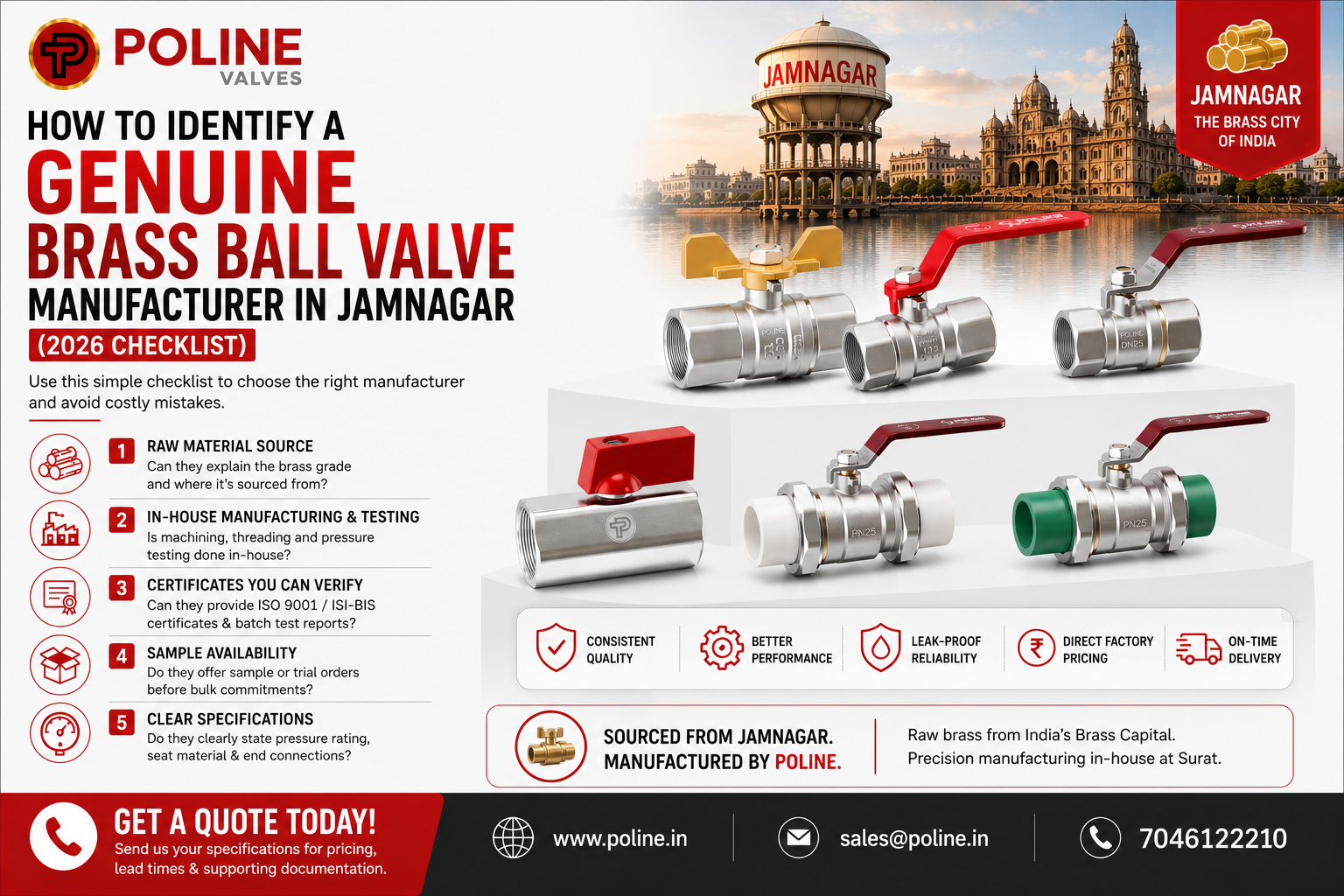
Search "brass ball valve manufacturer in Jamnagar" and you'll get hundreds of results — traders, resellers, and manufacturers all competing for the same click. The problem is, most buyers can't tell the difference until an order goes wrong: wrong alloy, inconsistent batches, or a "manufacturer" who is actually just repackaging someone else's stock.
This isn't another list of why Jamnagar is famous for brass — you probably already know that. This is a practical checklist for separating a real brass ball valve manufacturer from a trader claiming to be one, before you commit to an order.
Red Flag #1: They Can't Explain Their Raw Material Source
A genuine manufacturer knows exactly where their brass comes from — the alloy grade, the supplier, and how it's tested on arrival. If a supplier gives you a vague answer like "we get quality brass" without specifics on composition (e.g. CuZn39Pb3 / CW617N) or source, that's a sign you're dealing with a trader, not a manufacturer. (If you're not sure why the alloy grade even matters, our guide on CW617N vs CW614N for ball valves breaks down how the two most common grades affect strength, machinability, and pressure handling.)
What to ask: "What brass grade do you use, and where is it sourced from?"
At Poline, our raw brass is sourced directly from Jamnagar — India's largest brass manufacturing hub — before we machine, finish, and pressure-test every valve in-house at our Surat facility. That traceability is something we can walk you through in detail, because we control that part of the process ourselves.
Red Flag #2: No In-House Machining or Testing
Many sellers outsource machining, threading, and finishing to third parties, then simply assemble and label the final product. This makes quality control nearly impossible to guarantee, since no single facility is accountable for the entire process.
What to ask: "Is machining, threading, and pressure testing done in-house, or outsourced?"
An in-house setup means one facility is responsible for every stage — machining tolerances, seat quality, and final pressure testing — which is the difference between a valve that's consistent batch after batch and one that isn't. This matters even more for forged brass ball valves built for gas and water lines, where a single weak seal or off-spec forging can mean a leak under real operating pressure.
Red Flag #3: Certificates That Don't Hold Up to Scrutiny
Anyone can put "ISO certified" on a website. A real manufacturer will readily share their actual ISO 9001 certificate, ISI/BIS marking documentation, and material test certificates (MTCs) for specific batches — not just a logo on a webpage.
What to ask: "Can you send me your ISO certificate and a material test certificate for this specific batch?"
You can see Poline's actual certifications here rather than taking a website badge at face value.
Red Flag #4: No Willingness to Provide Samples
A confident manufacturer will offer sample or trial orders before you commit to bulk quantities. If a supplier pushes you straight to a large minimum order without offering samples, that's a warning sign — they may be more interested in a quick sale than a long-term relationship.
What to ask: "Can I get a sample order first to evaluate quality before placing a bulk order?"
Red Flag #5: Vague Answers on Pressure Ratings and Sealing Material
Every legitimate brass ball valve has a defined pressure rating (commonly PN 16–PN 40) and a specified seat material (PTFE being the industry standard). If a supplier can't confirm these specifications clearly for the exact product you're ordering, treat that as a gap in their technical knowledge — or their transparency. If you're still deciding whether brass is even the right material for your application, our Brass vs Stainless Steel Valves comparison is a useful starting point before you get into supplier-specific specs.
What to ask: "What's the pressure rating and seat material for this specific valve model?"
For union-end applications specifically, it's also worth checking our guide on UPVC, CPVC & PPR brass union ball valves, since pressure rating requirements can shift depending on the pipe material you're connecting to.
A Quick Manufacturer Evaluation Checklist
Before finalizing your supplier, run through this list:
- They can name their exact brass alloy grade and raw material source
- Machining, threading, and testing happen in-house (not outsourced)
- They provide real ISO 9001 / ISI-BIS certificates and batch-specific MTCs
- They offer sample or trial orders before bulk commitments
- They clearly state pressure ratings, seat material, and end connections for each model
- They have a track record of supplying distributors or contractors in your region
- Communication is responsive and specification-focused, not just sales-focused
If a supplier checks most or all of these boxes, you're likely dealing with a genuine brass ball valve manufacturer — not a reseller riding on Jamnagar's reputation.
Where Poline Fits In
Poline Technologies Pvt. Ltd manufactures brass ball valves from our facility in Surat, sourcing raw brass directly from Jamnagar's supply chain and handling machining, threading, pressure-testing, and finishing entirely in-house. We supply distributors, plumbing contractors, and industrial buyers across Jamnagar, Rajkot, and the wider Saurashtra region, with ISO 9001 processes and ISI/BIS-compliant options.
If you're evaluating suppliers using the checklist above, we're happy to answer every question on it directly — brass grade, testing process, certificates, and sample availability included. For a closer look at how our Jamnagar sourcing and Surat manufacturing process works together, see our detailed guide to sourcing brass ball valves connected to Jamnagar. You can also browse our full range of brass ball valves and the complete brass valves category to see specific models, sizes, and end connections.
Get a Quote
Send us your specifications — size, pressure rating, end connection type, and order quantity — and we'll respond with pricing, lead times, and the documentation to back it up. You can also check who we are and our production capabilities or explore the industries we serve to see how our valves are used across sectors.