
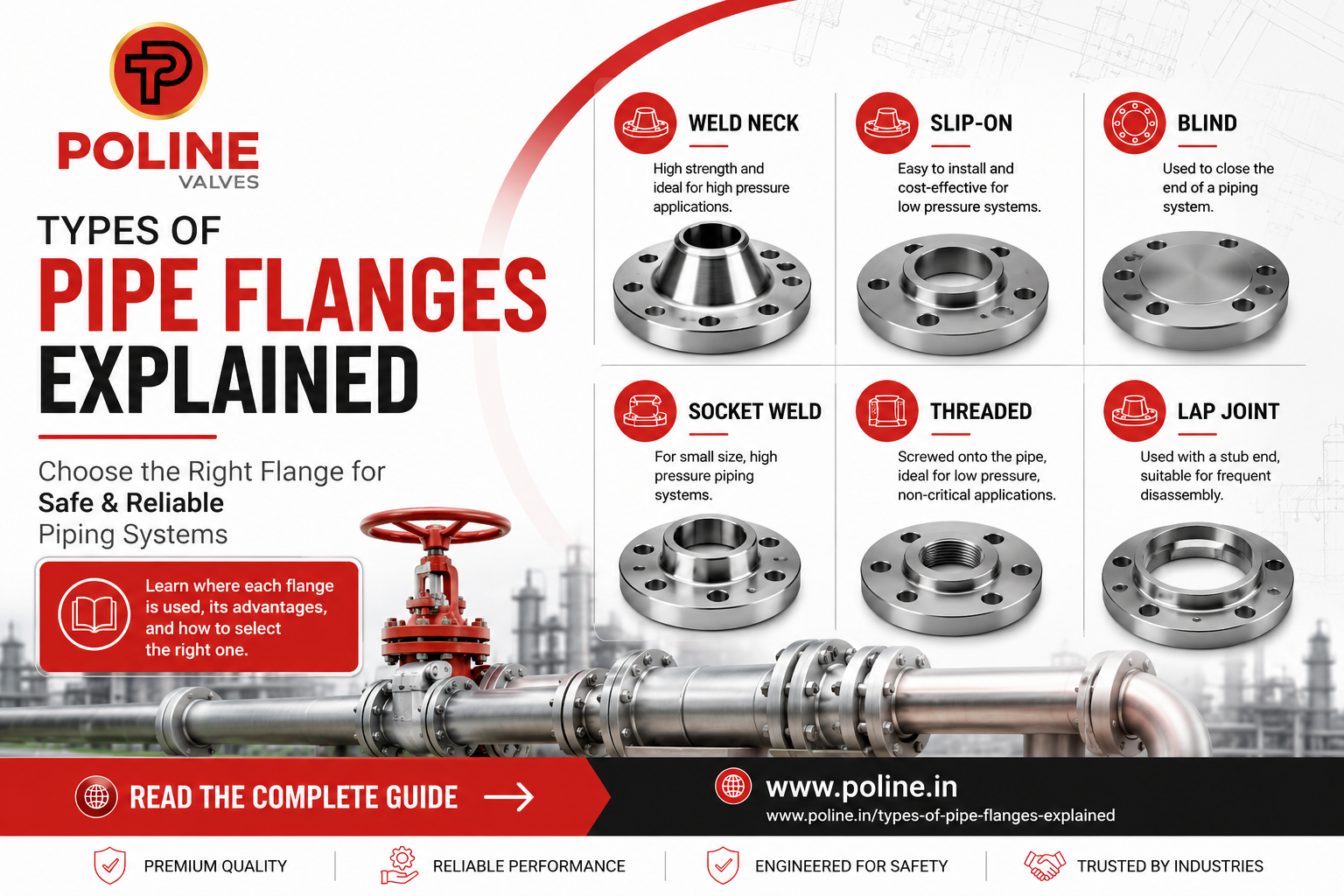
If you work with industrial piping systems, you already know that a flange is far more than a simple metal ring. It's the connection point that holds your entire system together — linking pipes, valves, pumps, and other equipment while allowing easy access for inspection, cleaning, and repair.
But not all flanges are built the same way, and choosing the wrong type can lead to leaks, pressure loss, or costly downtime. In this guide, we break down the most common types of pipe flanges, how they differ, and how to pick the right one for your application.
What Is a Pipe Flange?
A pipe flange is a fitting used to connect pipes, valves, pumps, and other equipment to form a piping system. Unlike welded or permanent joints, flanged connections are bolted together, which makes maintenance and system modification far simpler. Flanges are sealed using gaskets placed between two mating flange faces.
Flanges are typically classified by two things:
- Type (how they attach to the pipe)
- Facing (how the sealing surface is machined)
Let's look at the six most widely used flange types.
1. Weld Neck Flange
The Weld Neck flange is easily identified by its long, tapered hub that transitions smoothly into the pipe wall thickness. It is butt-welded to the pipe, creating a permanent, high-strength joint.
Best for: High-pressure, high-temperature applications, and services involving severe cyclic loading, such as steam lines, oil & gas piping, and process industries.
Why engineers prefer it: The gradual thickness transition reduces stress concentration at the base of the flange, making it one of the most reliable flange types for demanding conditions.
2. Slip-On Flange
A Slip-On flange slides over the pipe and is fillet-welded both inside and outside for strength. It's easier to align during installation compared to a Weld Neck flange.
Best for: Low-pressure applications such as water supply lines, HVAC systems, and general plumbing where cost and ease of installation matter more than extreme pressure ratings.
Trade-off: Slip-On flanges have lower fatigue strength than Weld Neck flanges under cyclic loading, so they aren't recommended for high-stress services.
3. Blind Flange
A Blind Flange has no bore — it's a solid disc used to seal the end of a pipe, valve, or pressure vessel opening. It allows a line to be closed off completely while still being easy to open later for inspection or future expansion.
Best for: Closing off pipeline ends, isolating sections of a system, and pressure testing.
Note: Because blind flanges bear full system pressure across a solid face, they experience the highest stress of any flange type and must be sized carefully for the application.
4. Socket Weld Flange
Socket Weld flanges have a machined recess (socket) that the pipe slides into before being fillet-welded in place. This creates a smooth internal bore with no gap for turbulence.
Best for: Small-diameter, high-pressure piping systems, such as instrumentation lines and hydraulic systems.
Limitation: Not typically recommended for services involving severe temperature cycling, corrosion, or where a small gap (required for weld shrinkage) could trap process fluid.
5. Threaded Flange
A Threaded (or Screwed) flange attaches to pipe using matching threads instead of welding. This eliminates the need for welding equipment on-site.
Best for: Applications where welding isn't practical — for example, hazardous environments, low-pressure gas lines, or field installations requiring quick assembly.
Trade-off: Threaded connections are more prone to leakage under temperature cycling or vibration, since threads can loosen over time.
6. Lap Joint Flange
A Lap Joint flange is used in conjunction with a separate stub end. The flange itself isn't welded to the pipe — it rotates freely around the stub end, allowing bolt holes to be aligned easily.
Best for: Systems requiring frequent dismantling for inspection or cleaning, and piping systems using expensive alloy or exotic materials (since the flange itself can be made of cheaper carbon steel while only the stub end touches the process fluid).
Quick Comparison Table
| Flange Type | Connection Method | Pressure Rating | Common Use Case |
|---|---|---|---|
| Weld Neck | Butt-welded | High | Steam, oil & gas, high-pressure process lines |
| Slip-On | Fillet-welded | Low to Moderate | Water supply, HVAC, general plumbing |
| Blind | Bolted (no bore) | Varies (high stress) | Line termination, isolation, testing |
| Socket Weld | Fillet-welded (socket) | High | Small-bore, high-pressure lines |
| Threaded | Threaded, no welding | Low | Field assembly, hazardous areas |
| Lap Joint | Rotates on stub end | Low to Moderate | Frequent maintenance, alloy piping |
How to Choose the Right Flange
When selecting a flange for your piping system, consider these factors:
- Operating Pressure and Temperature – Higher demands typically call for Weld Neck flanges.
- Pipe Material and Size – Small-bore, high-pressure lines often use Socket Weld flanges.
- Maintenance Frequency – Systems requiring regular dismantling benefit from Lap Joint flanges.
- Installation Conditions – If welding isn't feasible on-site, Threaded flanges are a practical choice.
- Compliance Standards – Ensure the flange matches applicable standards (ASME B16.5, EN 1092-1, etc.) and the correct pressure class (PN or ANSI rating) for your system.
Final Thoughts
Choosing the correct flange type isn't just a technical detail — it directly affects the safety, efficiency, and longevity of your piping system. Whether you're designing a high-pressure steam line or a straightforward water supply network, matching the flange type to your application's pressure, temperature, and maintenance needs will save you from costly failures down the line.
At Poline, we manufacture and supply a wide range of industrial flanges and valves built to meet international standards. If you're unsure which flange type suits your project, our team is happy to help you specify the right fit.
FAQs
Q: What is the difference between a Weld Neck and a Slip-On flange? A Weld Neck flange has a tapered hub and is butt-welded for high-strength, high-pressure use, while a Slip-On flange slides over the pipe and is fillet-welded, making it easier to install but suited to lower-pressure applications.
Q: Which flange type is best for high-pressure steam systems? Weld Neck flanges are generally preferred for high-pressure and high-temperature steam systems due to their superior strength and resistance to stress concentration.
Q: Can a Blind Flange be reopened after installation? Yes. Unlike a permanent cap, a Blind Flange is bolted on, so it can be removed for future access, inspection, or system expansion.