
India's rural tap water coverage under the Jal Jeevan Mission crossed 82% in July 2026, and the mission has just been extended to 2028 with an ₹8.69 lakh crore outlay. That means a lot more pipe, and a lot more valves, going into the ground this year — here's how to pick the right one.
Jal Jeevan Mission 2.0, approved by the Union Cabinet in March 2026, pushed the completion target for "Har Ghar Jal" out to December 2028 and set a minimum service standard of 55 litres per capita per day of potable water meeting BIS 10500 quality norms. Rural tap water coverage has already climbed to 82.09% of households, up from just 16.71% when the mission launched in 2019. Alongside this, urban water utilities, housing societies, and EPC contractors are laying and retrofitting distribution lines at a scale India hasn't seen before.
Every one of those lines needs isolation and control points — and the two workhorses of water supply valving, the ball valve and the gate valve, are not interchangeable. Picking the wrong one for a given point in the system leads to slow shutdowns, unnecessary pressure loss, water hammer, or a valve that simply wears out too fast for how it's being used. This guide walks through how each type actually works, where each one belongs in a water supply system, and a selection checklist you can run before finalising your BOQ.
How Ball Valves and Gate Valves Actually Work
A ball valve uses a bored sphere inside the body. A quarter turn (90°) of the handle rotates the ball so its bore either lines up with the pipe (fully open) or sits perpendicular to it (fully closed). That quarter-turn action means near-instant shut-off, a very reliable seal even after long periods of disuse, and a compact footprint.
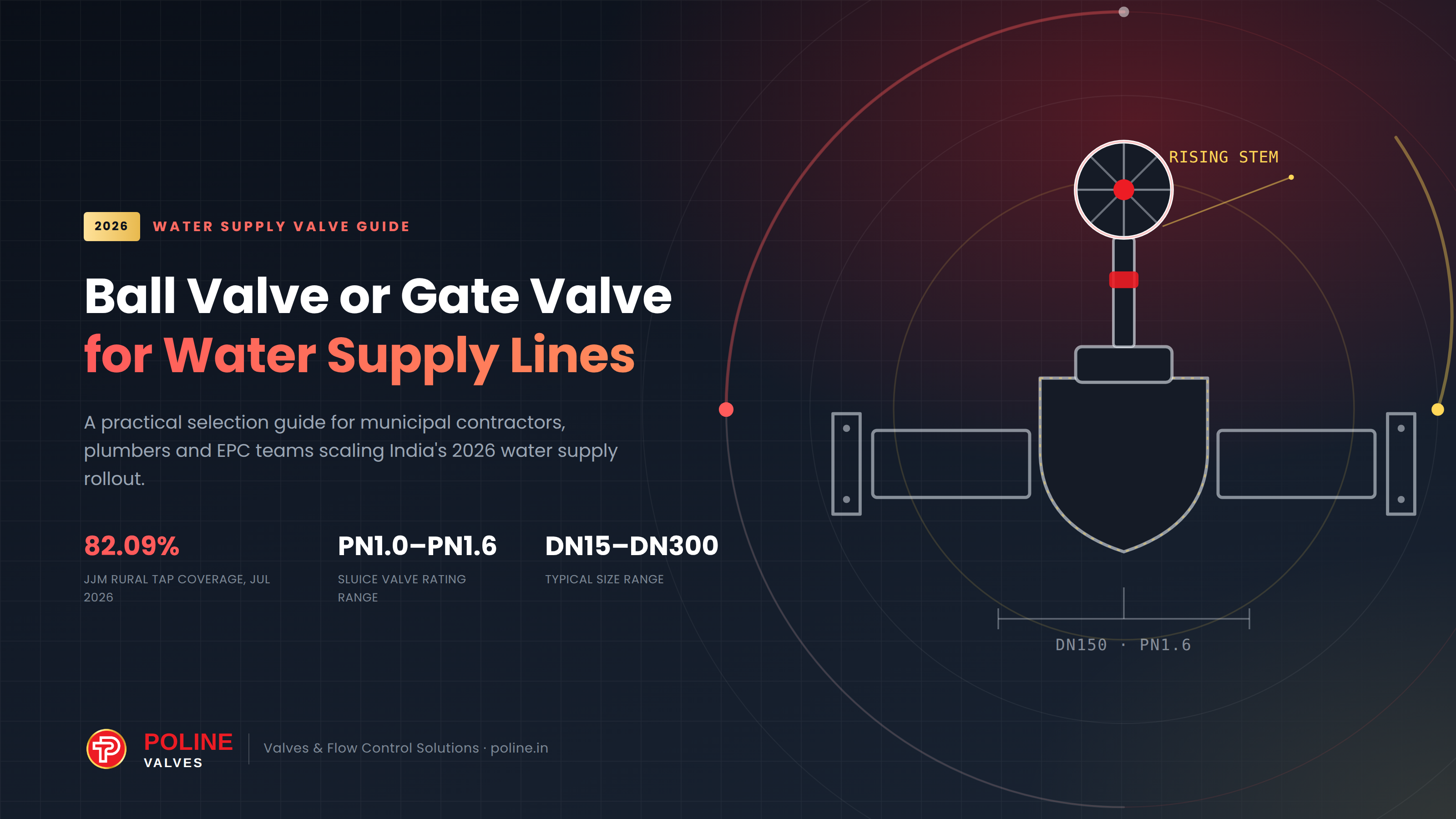
A gate valve uses a flat wedge or disc (the "gate") that lowers into the flow path via a threaded stem, either rising above the valve as it opens (rising stem) or staying at a fixed height with the threads inside the body (non-rising stem, common where headroom is limited). Because the gate has to travel the full height of the waterway, opening or closing takes several turns of the handwheel — but when fully open, a gate valve offers a nearly unobstructed, full-bore flow path with very little pressure drop, which is exactly why it dominates large-diameter transmission and distribution mains.
When a Ball Valve Is the Right Choice
Ball valves suit points in the system where quick, frequent operation matters more than absolute minimum pressure drop:
- Individual household/building connections and meter isolation points — a resident or plumber needs to be able to shut off supply in one quick motion, often without special tools.
- Smaller-diameter branch lines and risers inside buildings and housing societies, where a compact valve body is an advantage.
- Points needing a bubble-tight, long-term seal even with infrequent operation — ball valves resist seizing better than gate valves left in one position for years, since there's no fine-threaded stem mechanism to corrode.
Poline's ball valve range covers this end of the system well: forged brass valves in the Callisto and Titan series — forging, and why it matters for pressure-retaining duty, is the same reason we recommend it for gas valves in our forged brass ball valves guide — available in 1-piece, 2-piece and 3-piece body configurations with screwed or flanged ends, alongside cast iron, cast steel, forged steel, bronze, and stainless steel (SS304/SS316/WCB) options for larger or more corrosive-duty branch lines. We've gone deeper into brass grade selection in our CW617N vs CW614N comparison and the broader material trade-off in our brass vs stainless steel valves comparison, both directly relevant when you're specifying ball valves for a water job.
When a Gate Valve Is the Right Choice
Gate valves are the standard choice for mainline isolation on larger-diameter transmission and distribution pipework — exactly the kind of infrastructure being extended under Jal Jeevan Mission 2.0 and municipal augmentation schemes:
- Trunk mains and distribution mains, where full-bore flow with negligible pressure drop matters more than fast operation, since these lines are opened and closed rarely (commissioning, major repairs, zone isolation).
- Underground and buried service — sluice valves (a common name for gate valves in waterworks) are built with the specific corrosion protection, extension spindles, and surface box arrangements that buried municipal mains need.
- Large-diameter zone and sectional valves in a distribution network, where an operator has time to turn a handwheel through several rotations, and the trade-off of slower operation for lower long-term wear and better sealing at large sizes is the right one.
Poline's gate valve range is built specifically for this duty: Cast Iron Sluice Valves(PN1.6 and PN1.0 ratings), a Ductile Iron Resilient Seated Gate Valve (PN1.6) for a tighter, more corrosion-resistant seal, and a Cast Steel Gate Valve for higher-pressure or industrial-adjacent applications — available in both rising-stem and non-rising-stem configurations depending on the headroom and visual position-indication needs at each installation point.
Selection Checklist Before You Finalise a Water Supply Valve
Run through this before any valve gets written into your water supply BOQ:
- How often will it actually be operated? Frequent, quick isolation → ball valve. Rare, planned isolation on a mainline → gate valve.
- What's the pipe diameter? Ball valves dominate smaller branch and connection sizes; gate valves become the practical (and often the only sensible) choice as diameters grow into mainline territory.
- What's the pressure rating you actually need? Match the valve's PN rating to your system's real working and test pressure — Poline's sluice valves span PN1.0 to PN1.6, so confirm which one your zone requires rather than defaulting to whichever is in stock.
- Is the valve buried or exposed? Buried mainline valves need spindle extensions, surface boxes, and coatings rated for underground service — don't specify an above-ground valve for a buried application.
- Rising or non-rising stem? Choose rising-stem where headroom allows and visual position indication is useful (an operator can see the stem height to confirm open/closed); choose non-rising-stem where space is tight or the valve sits in a confined chamber.
- Is debris protection needed upstream? In retrofit or older-network connections especially, install a Y-strainer ahead of the valve to protect the seat and seal from sediment and construction debris — this matters even more on newly commissioned Jal Jeevan Mission lines where pipeline flushing may be incomplete.
- Documentation and standards. Ask for material test certificates and confirm ISO-compliant manufacturing, especially for anything going into a government-funded scheme where audits are increasingly routine.
A Real-World Scenario
An EPC contractor executing a Jal Jeevan Mission distribution upgrade in a semi-urban zone used ball valves on the 200mm zone-isolation points to save on cost and installation time, reasoning that "a valve is a valve, and ball valves shut off faster anyway." Within months, operators reported difficulty even turning the valve handles at that size, and one valve seized entirely during a planned maintenance shutdown, delaying the isolation and forcing an emergency downstream closure instead.
The contractor swapped the zone-isolation points for properly rated ductile iron resilient-seated gate valves, sized and rated for the mainline duty. Operation became a routine multi-turn handwheel task exactly as expected for that size and duty, position was visible from stem height, and the fitting sailed through the utility's commissioning inspection without objection.
Choosing the "faster" valve for the wrong point in the system created more downtime, not less — matching the valve type to its actual duty point is what actually delivers reliability.
Common Mistakes to Avoid
- Using a gate valve for frequent on/off duty. Repeated full-travel operation on a gate valve accelerates wear on the stem threads and seat far faster than the same duty on a ball valve.
- Using a ball valve at large mainline diameters purely for faster operation, without accounting for cost, torque requirements, and the pressure-drop difference at full bore.
- Skipping the strainer on retrofit or newly commissioned lines, then blaming the valve when sediment scores the seat.
- Guessing the PN rating instead of confirming actual working and test pressure for that specific zone or connection point.
- Ignoring rising vs non-rising stem clearance — installing a rising-stem gate valve in a chamber with insufficient headroom for the stem to travel when open.
How Poline Can Support Your Next Water Supply Project
As a manufacturer of brass, cast iron, ductile iron, cast steel, and stainless steel valves for water, gas, and industrial applications, Poline Technologies works with EPC contractors, municipal bodies, plumbers, and housing societies to get water supply valve specification right the first time — including cast iron and ductile iron sluice/gate valves, forged brass and stainless steel ball valves, and Y-strainers to protect them.
If your project is part of this year's Jal Jeevan Mission 2.0 push or a municipal augmentation scheme, now is the time to review your valve specification by duty point rather than by habit.
Talk to Our Team → Browse Gate Valves