
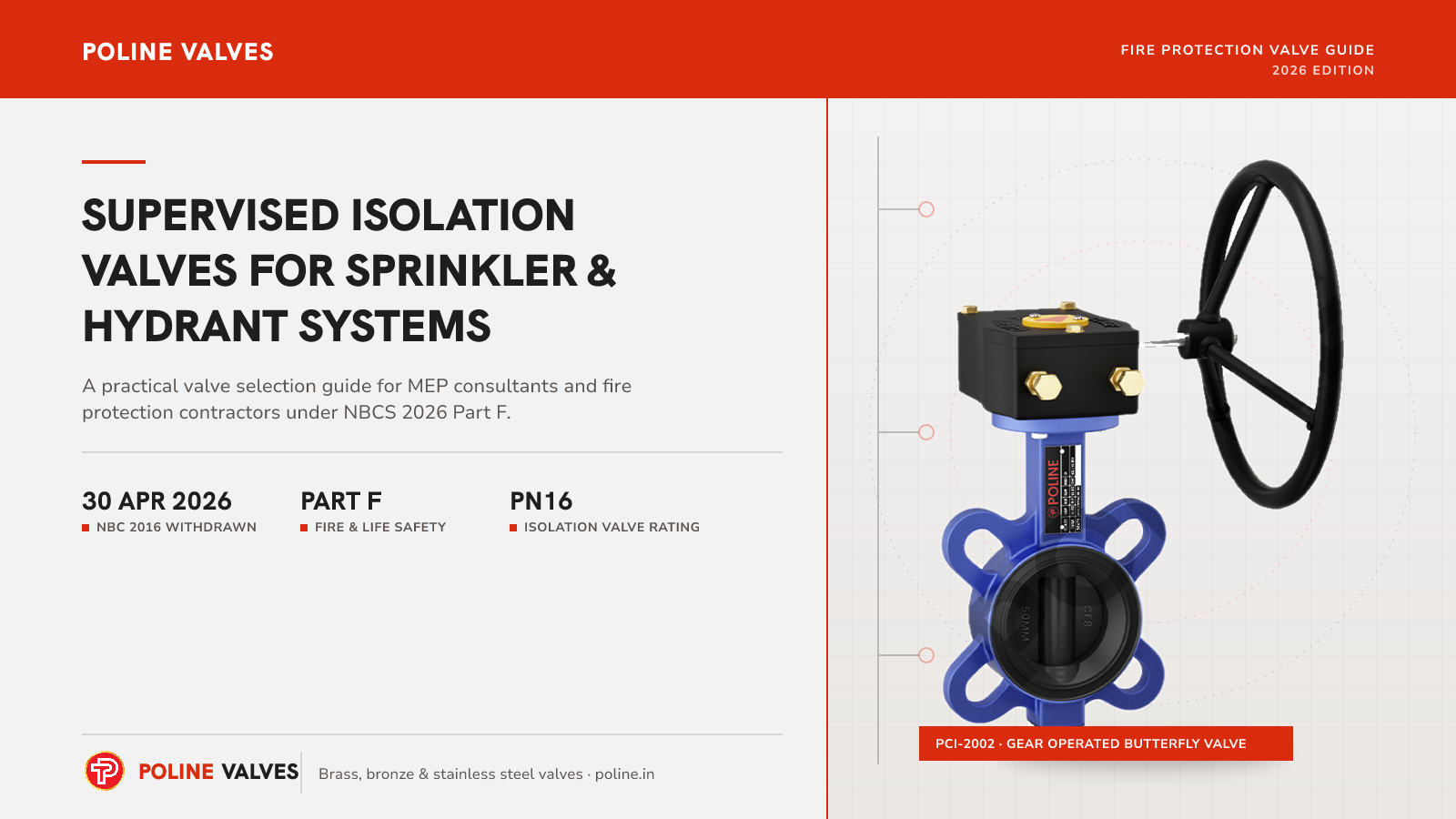
On 30 April 2026, the Bureau of Indian Standards withdrew the National Building Code 2016 and notified SP 7:2026 — the National Building Construction Standards (NBCS 2026). Fire and life safety, formerly Part 4, is now Part F. Buried in its fire alarm clause is a requirement that reaches directly into the valve schedule: where an automatic fire alarm system is provided, the panel should monitor every isolation valve fitted with a supervisory switch, alongside hydrant and sprinkler pressures and pump status. The valve that shuts down a sprinkler zone is no longer just a maintenance fitting. It's part of the monitored system, or it's supposed to be.
NBCS 2026 Part F is explicit about its own status: it describes itself as “voluntary in nature and is non-binding,” with implementation depending on adoption by the state or local authority into byelaws, or by a contract or tender specification that requires it. Fire services sit under the Twelfth Schedule as a State subject, so what actually governs a given building is the state fire services act, local development control regulations, and the conditions on that building's fire NOC — not the national document by itself. That said, NBCS 2026 is the reference auditors, insurers, and consultants will increasingly reach for, and states adopt it over time. Treating it as irrelevant until your state formally adopts it would be a mistake; treating its clause numbers as automatically binding on every building would be an equally real one. Confirm with your local fire authority before specifying to it as law.
What doesn't need confirming is the underlying logic, because it isn't new. A closed, unmonitored isolation valve on a sprinkler or hydrant riser is one of the most consistently cited causes of suppression failure in fire investigations — not a defective valve, just a valve someone shut for maintenance, a renovation, or a false alarm, and never reopened. NBCS 2026's answer is to make the valve's position part of what the fire alarm panel watches. That has a direct consequence for what gets specified on the drawing: not every gate or butterfly valve can carry a supervisory switch, and the ones chosen for isolation duty need to be selected with that in mind from the start.
What a Supervised Isolation Valve Actually Is
A supervisory (or tamper) switch is a small electrical switch mounted on an isolation valve's stem or gearbox that reports the valve's position — normally open — back to the fire alarm control panel. If the valve is closed, or turned more than a couple of rotations off its fully open position, the switch trips a supervisory signal at the panel, distinct from a fire alarm, flagging that someone has interfered with the water supply to that zone. It doesn't stop anyone from closing the valve. It stops the closure from going unnoticed for the six months between annual inspections.
This only works with valve types built to accept the mechanism reliably: gear-operated butterfly valves with a visible position indicator, or OS&Y (outside screw and yoke) gate valves where the rising stem itself shows open/closed status at a glance. A plain lever-operated quarter-turn valve can technically take a switch, but it's a poor fit for a monitored zone isolation point — the lever gives no intermediate position feedback and is easy to bump partially shut without anyone registering it. In Indian sprinkler and hydrant installations, gear-operated PN16 butterfly valves have become the practical default for this role precisely because the gearbox and indicator are already part of the valve, not a retrofit.
Where Isolation Valves Belong in a Fire Protection System
- Sectional/zone control valves on sprinkler risers — one per floor or protected zone, so a fault or maintenance need in one zone doesn't take the whole system out of service. These are the valves clause 4.9(j) is aimed at.
- Main isolation valve on the hydrant wet riser, typically at the base of the riser and repeated at each landing valve connection, controlling water to that floor's hose reel and landing valve.
- Valve ahead of pressure gauges and test points on the riser, so gauges and flow-test connections can be isolated for servicing without draining the whole system.
- Check valve (NRV) at the fire pump discharge, preventing water in the charged system from running back through the pump when it's idle, and keeping the jockey pump from cycling against a falling column.
- Not typically fitted with a supervisory switch: valves on branch lines feeding individual sprinkler heads, where a switch on every fitting would be neither standard practice nor useful signal.
Fire Protection Valve Selection Checklist
- Match the valve type to the supervisory requirement. If the design calls for a monitored isolation point, specify a gear-operated butterfly valve with position indicator or an OS&Y gate valve — not a lever-operated valve that happens to be on hand. Confirm the gearbox accommodates the switch model your fire alarm vendor uses before it's ordered.
- Size the pressure rating to the system, not the nominal pipe class. Most sprinkler and hydrant risers run at PN16, but check this against actual static pressure plus fire pump churn pressure at shutoff, which can exceed the nominal rating on taller or pump-boosted systems.
- Choose disc material for the water and duty. SG iron discs handle standard hydrant and sprinkler water; where the source water is corrosive, brackish, or the system sees long idle periods with stagnant water, an SS304 disc resists pitting better over the system's service life.
- Confirm liner compatibility. EPDM liners suit most ambient water service; nitrile liners are the better choice where oil traces or higher temperatures are a factor, such as pump rooms near diesel-driven fire pumps.
- Specify a visible position indicator on every isolation valve, switch-monitored or not — someone doing a manual patrol between panel checks still needs to see open/closed status without guessing.
- Place a dual-plate check valve at the pump discharge, sized to API 594 design and API 598 tested, to prevent backflow into the pump and reduce water hammer on pump start/stop cycling.
- Keep documentation on file, not just in memory. Clause 3.3 of NBCS 2026 Part F puts the burden on the building to show that any alteration didn't reduce the fire and life safety level below what existed before — a requirement that's much easier to meet with material test certificates and valve records on hand than with an inspector's recollection.
- Verify local adoption before treating any of this as mandatory. Ask your fire authority whether NBCS 2026 has been taken into your state's byelaws and what your building's fire NOC actually requires — that document, not the national standard on its own, is what you're contractually and legally bound to meet.
A Real-World Scenario
A commercial building's annual fire audit found a sprinkler zone valve on the third floor turned three-quarters shut — closed during a ceiling renovation eight months earlier and never reopened. The valve had no supervisory switch and no position indicator visible from the corridor; the only way to catch it was a technician physically walking the riser and checking each valve by hand during the audit. For eight months, that zone would have received a fraction of its rated sprinkler flow in a fire.
The building's facility team replaced the plain lever butterfly valve with a gear-operated model fitted with a position indicator and a supervisory switch wired back to the fire alarm panel, closing the exact gap NBCS 2026 clause 4.9(j) is written to catch. The switch now reports valve status continuously, rather than depending on the next annual walk-through to notice.
The valve itself hadn't failed. Nobody had been watching it, and nothing was built to make that visible — which is a specification problem, not a maintenance one.
Common Mistakes to Avoid
- Specifying a lever-operated valve for a zone isolation point because it's cheaper or already in stock, then discovering it can't take a reliable supervisory switch later.
- Treating NBCS 2026 as automatically binding on every project without checking whether the state or local authority has actually adopted it — or, at the other extreme, dismissing it entirely because it says “voluntary.”
- Sizing isolation and check valves to the nominal pipe class rather than checking them against actual pump churn pressure, which can run higher than the riser's working pressure suggests.
- Skipping the position indicator on valves without a supervisory switch, leaving manual patrols to guess at valve status rather than read it.
- Losing track of test certificates and material records for fire protection valves specifically, even when the rest of the system's documentation is in order — exactly the kind of gap clause 3.3's “prove it didn't get worse” standard is designed to expose.
How Poline Can Support Your Fire Protection Valve Schedule
Poline Technologies manufactures gear- and lever-operated butterfly valves in PN16 and PN2.5 classes with SG iron or SS304 discs, purpose-built for sprinkler, hydrant, and HVAC isolation duty, alongside dual plate check valves designed to API 594 and tested to API 598 for fire pump discharge lines. Our full range for this application sits under fire fighting systems on our product catalogue. If you're specifying pressure class alongside valve type, our PN rating guide covers how PN16 compares with other classes in more depth.
We support fire protection contractors, MEP consultants, and building owners across fire fighting, water supply, and commercial infrastructure projects with valves specified for the duty, not just the pipe size — because a supervised isolation point is only as reliable as the valve underneath the switch.
Talk to Our Team → Browse Fire Fighting Valves