
India's PNG rollout is moving faster than ever in 2026 — and the one component that decides whether a new connection stays leak-free for fifteen years is the humble shut-off valve. Here's how to specify it correctly.
India's piped natural gas (PNG) network is expanding faster than at almost any point in the last decade. Under the government's National PNG Drive push and the newer Natural Gas and Petroleum Products Distribution Order, city gas distribution (CGD) companies gasified roughly 4.4 lakh new connections in just the weeks after March 2026, with lakhs more households and housing societies registered and waiting for their line to be laid. If you are an installer, EPC contractor, OEM, or a housing society management committee anywhere in this pipeline, one small component decides whether that new connection is safe and trouble-free for the next fifteen years: the valve.
A PNG line is only as reliable as its weakest isolation point. In this guide, we will walk through where valves sit in a PNG system, which valve types and materials are actually meant for gas duty, the checklist you should run before approving any valve for a gas connection, and the mistakes that keep showing up on live sites even in 2026.
Where Valves Actually Sit in a PNG System
A typical PNG installation — whether it's a single flat, a housing society riser, or a commercial kitchen — has valves at several critical points:
- The meter isolation valve, immediately before or after the gas meter, used by the utility or resident to cut supply for maintenance or emergencies.
- The riser/branch valves on multi-storey buildings, where the vertical gas riser splits off to each floor.
- The appliance isolation valve, the last point of control before a stove, geyser, or commercial burner.
- Non-return valves (NRVs) at compressor or booster points in larger commercial and industrial gas setups, preventing backflow into the network.
Every one of these is a shut-off point that residents, technicians, or emergency responders may need to operate quickly, sometimes years after installation without regular maintenance. That is exactly why the valve specification matters more here than almost anywhere else in a building's utilities.
Valve Types and Materials Built for Gas Duty
Not every ball valve on a shelf is a gas valve, even if it looks identical to one. For PNG and LPG lines, the industry has converged on a few proven choices.
Forged brass ball valves remain the standard for domestic and commercial PNG connections. Forging (rather than casting) gives the body a denser, more uniform grain structure, which matters directly for gas safety — fewer hidden porosity pockets means fewer slow leaks at threads and seats. We've covered why forging matters for pressure-retaining gas and water valves in more depth in our forged brass ball valves guide.
Brass grade matters too. Most quality gas ball valves use CW617N forging brass for the body, sometimes paired with free-machining CW614N for the stem or ball where machinability matters more than forging strength. If you specify valves by brass grade rather than just "brass," you avoid a lot of ambiguity with suppliers — we've broken down exactly how CW617N and CW614N compare for anyone writing a purchase specification.
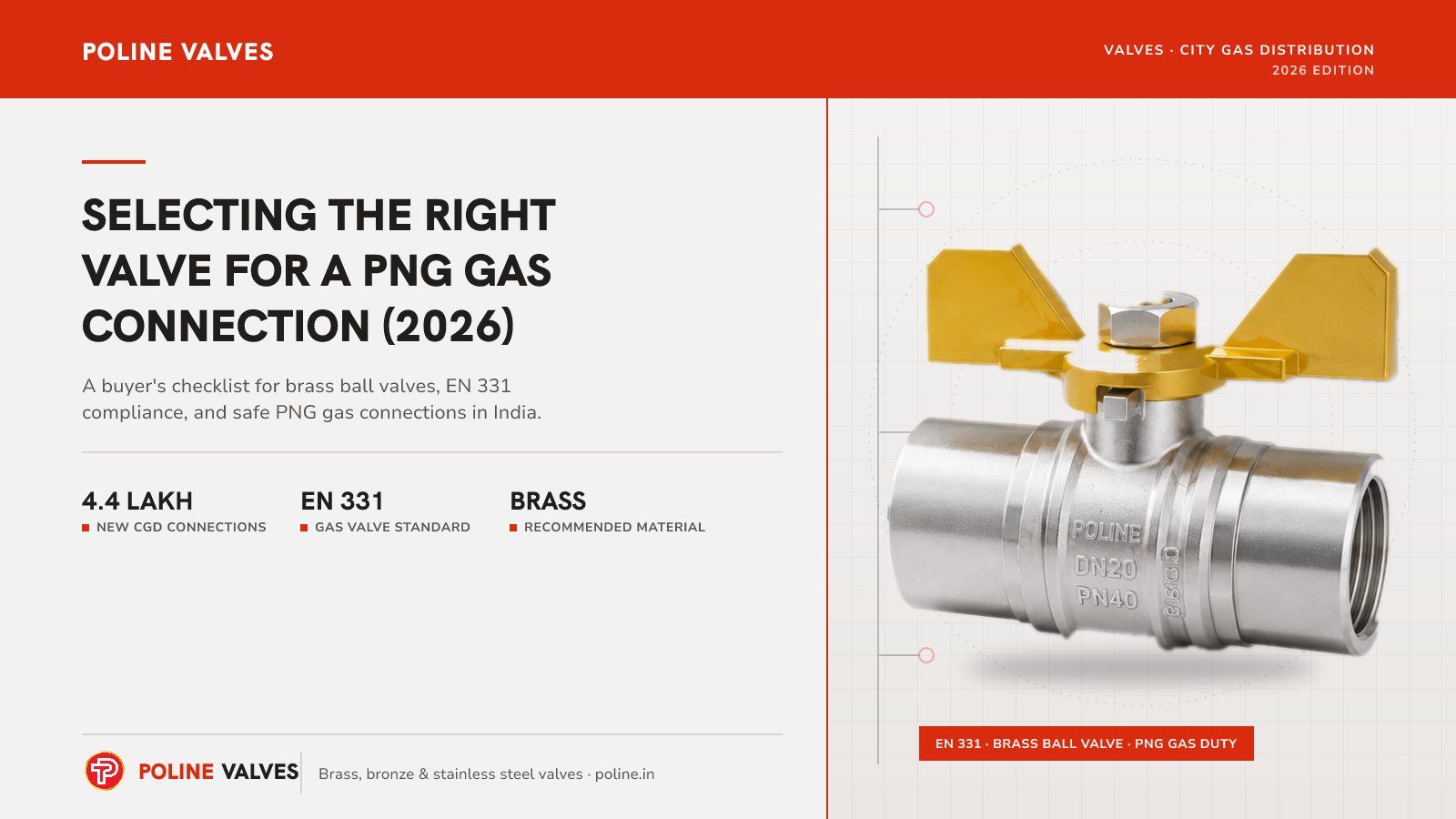
Manually operated gas ball valves built to EN 331 are the recognised category for shut-off valves in gas installations in buildings — covering design, testing, and performance expectations specific to gas rather than water or air service. When you're sourcing valves for a PNG job, ask specifically for EN 331-compliant gas valves rather than a generic ball valve, since general-purpose valves are not tested to the same gas-tightness requirements.
For the material question itself — brass versus stainless steel — most residential and CGD-scale PNG work stays with brass for cost and adequate corrosion resistance, while stainless steel is reserved for more aggressive industrial gas applications. We go through the trade-offs in our brass vs stainless steel valves comparison if you're specifying across both domestic and industrial scope in the same project.
Selection Checklist Before You Approve a PNG Valve
Run through this before any valve gets written into your PNG installation BOQ:
- Confirm gas-specific certification. Ask explicitly whether the valve is rated and tested for gas service (EN 331 or equivalent), not just a general-purpose water/air ball valve being sold for gas.
- Check the brass grade and forging process. Confirm the body is forged CW617N (or equivalent), not a cast or low-grade casting dressed up as forged.
- Verify pressure and temperature rating against your actual system design — PNG distribution pressures and appliance-side pressures are very different, and the valve should be rated for the specific point in the system it will occupy.
- Insist on 100% factory leak testing, not sampling-based testing, for every valve going into a gas line — this is non-negotiable for gas safety.
- Check thread and sealing quality. Clean, burr-free machining and properly seated PTFE seals directly determine whether a valve seeps at the joint within the first year.
- Ask for documentation. Test certificates, batch traceability, and material data should be available on request — CGD companies and building safety audits increasingly expect this paperwork.
- Match the valve to its location. A meter isolation valve, a riser valve, and an appliance valve don't always need identical specifications — oversizing or undersizing at any of these points causes either sluggish operation or excess pressure drop.
A Real-World Scenario
A housing society in the middle of a CGD rollout decided to save on installation cost by fitting low-cost, unbranded ball valves at each floor's riser branch, assuming "a valve is a valve." Within the first year, residents on two floors reported a faint gas smell near the riser cupboard. When the maintenance team investigated, they found sweating and micro-leakage at the valve body threads — the valves had not been forged, and had inconsistent wall thickness that let seepage develop slowly under normal pressure and temperature cycling.
The society replaced every riser valve with properly forged, EN 331-tested brass ball valves, each backed by a factory leak-test certificate. Leakage complaints stopped, the gas utility's safety audit passed without objections, and the facility team no longer had to schedule emergency shutdowns for valve replacement.
The cost difference upfront was small; the difference in call-outs, resident complaints, and safety risk over the following years was not.
Common Mistakes to Avoid
- Treating "brass-coloured" as "brass-graded." Confirm the actual alloy and forging process rather than trusting appearance or price alone.
- Reusing water valves for gas points because they were already on site — water and gas valves are not interchangeable even when the end connections look identical.
- Skipping documentation because a project is running behind schedule — missing test certificates become a real problem at the safety audit stage, not before.
- Ignoring the appliance-end valve while focusing only on the meter and riser — the last isolation point before a stove or geyser sees the most day-to-day operation and deserves equal attention.
How Poline Can Support Your Next PNG Project
As a specialist manufacturer of brass ball valves, gas valves, and flow-control solutions for city gas distribution, water, and industrial utilities, Poline Technologies works with EPC contractors, gas installers, OEMs, and housing societies to get the valve specification right the first time — including EN 331-tested gas and CGD valves, forged brass ball valves, and check valves for backflow protection at booster and compressor points.
If your PNG connection is part of this year's expansion push, or if you're auditing an existing installation for leakage risk, now is the right time to review your valve specification rather than after a complaint.
Talk to Our Team → Browse Gas Valves