
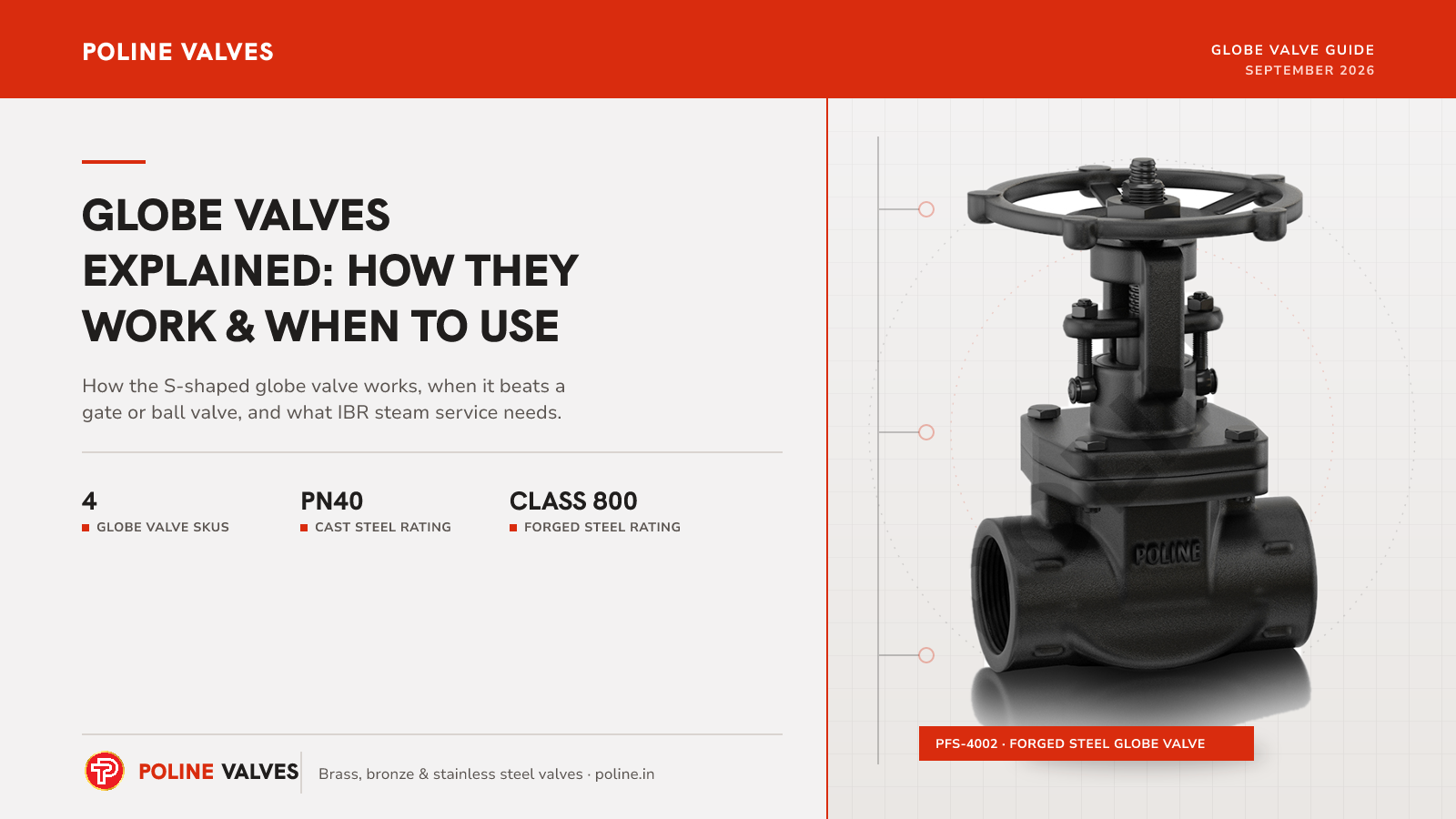
Boiler India 2026 — the country's largest steam and boiler trade show — opens October 8 at the CIDCO Exhibition Centre in Navi Mumbai, bringing together boiler makers, EPC contractors, and component suppliers from over 30 countries. It's a fitting moment to look at a valve type that rarely gets its own explainer despite sitting at the center of almost every steam system on that show floor: the globe valve. Buyers researching ball valves, gate valves, and butterfly valves can find plenty written about each — but “what is a globe valve” is a question that often gets a one-line answer buried inside a broader comparison. This guide fixes that gap: how a globe valve actually works, why its shape makes it different from a gate or ball valve, and what to check before specifying one for steam or boiler service in India.
What a Globe Valve Actually Is
A globe valve gets its name from the historically spherical shape of its body, though most modern industrial versions — including cast steel and forged steel globe valves — use an S-shaped or Z-shaped internal flow path rather than a true sphere. Inside, a disc sits above a circular seat, positioned perpendicular to the direction of flow. A threaded stem, turned by a handwheel, raises or lowers that disc directly onto or away from the seat. As the disc lifts, fluid enters below the seat, changes direction to pass through the seat opening, and changes direction again on its way out.
That double change in flow direction is the defining trait of a globe valve, and it's the reason globe valves behave differently from almost every other valve type on a piping isometric. It creates more pressure drop across the valve than a straight-through design like a gate valve, which is a genuine trade-off. But it also means the flow area changes smoothly and predictably as the disc travels — which is exactly what you need for throttling, and exactly what a gate valve's wedge and a ball valve's rotating ball are poorly suited to do.
Globe Valve vs Gate Valve vs Ball Valve: When Each Wins
The three valve types get compared constantly because they're often candidates for the same line, but they're built to do different jobs.
| Parameter | Globe Valve | Gate Valve | Ball Valve |
|---|---|---|---|
| Primary function | Throttling / flow regulation | On-off isolation | Quick on-off isolation |
| Flow path | Changes direction twice (S/Z-shaped) | Straight-through | Straight-through (when open) |
| Pressure drop | Higher, even fully open | Very low, fully open | Very low, fully open |
| Throttling suitability | Excellent — smooth, controllable | Poor — wire-drawing damages the wedge/seat | Poor — erosion damages the seat at partial turns |
| Operating motion | Multi-turn (linear disc travel) | Multi-turn (linear wedge travel) | Quarter-turn |
| Typical service | Steam, boiler feedwater, chemical dosing, bypass lines | Water mains, pipeline isolation, infrequent operation | Fast shutoff, CGD/gas distribution, frequent cycling |
The practical takeaway: if a line needs to be fully open or fully shut and stay that way, a gate or ball valve gives a lower, more efficient pressure drop. If a line needs to be throttled — held at a partial position to regulate flow, pressure, or temperature, and adjusted repeatedly — a globe valve is built for exactly that, and using a gate or ball valve for sustained partial-open duty will wear out its sealing surfaces well before its rated life. We cover that gate-vs-ball decision in more depth in our ball valve vs gate valve water supply guide.
Where Globe Valves Earn Their Keep
The throttling behavior above translates into a specific set of applications: steam distribution lines where flow needs fine regulation rather than a hard cutoff, boiler feedwater lines where flow rate has to track demand, chemical dosing and injection points where precise, repeatable partial-open positioning matters, bypass and recirculation lines around control valves, and any service where an operator needs to fine-tune flow by feel rather than snap it open or shut. It's also the reason globe valves show up so often as “stop valves” on boiler steam headers — a role that specifically calls for both a reliable shutoff and the ability to ease a line into service gradually rather than slamming it open against pressure.
IBR Compliance for Steam and Boiler Service in India
Any valve installed on boiler piping, mountings, or fittings in India — including globe valves used as boiler stop valves — falls within the scope of the Indian Boiler Regulations (IBR) 1950 once the service pressure exceeds the regulation's threshold, and IBR compliance is enforced by India's Central Boilers Board through a Competent/Inspecting Authority system, with design approval (Form III-C) and material and product testing and certification as part of that process. This isn't a paperwork formality — buyers specifying a globe valve for a boiler or steam application should ask the manufacturer directly whether the specific SKU carries current IBR approval and request the certificate, rather than assuming a general industrial-grade valve qualifies. If you're evaluating suppliers at Boiler India 2026 or elsewhere this quarter, that's the first document to ask for on any steam-service shortlist.
Poline's Globe Valve Range
Poline manufactures four globe valve SKUs across two material families, sized for the pressure classes that steam and boiler applications typically call for. The PCS-3001 Cast Steel Globe Steam Stop Valve is a flanged design rated for PN 40 service, built specifically for the steam stop-valve role described above. The PCS-3007 Cast Steel Globe Valve covers general Class 150 industrial process duty in the same cast steel body material. On the forged steel side, the PFS-4002 and PFS-4002A Forged Steel Globe Valves are Class 800 valves in standard-bore and full-bore configurations, built for higher-pressure process and steam applications where a forged (rather than cast) body is specified. All four are part of Poline's Boiler & Steam Applications range alongside the company's gate and check valves in the same material families.
Buyer's Checklist Before You Specify a Globe Valve
- Check the flow direction arrow on the body before installing it. Globe valves are directional — they're designed for flow to enter below the seat and lift the disc — and installing one backwards increases pressure drop, can cause the disc to slam against the seat under flow, and in some designs prevents the valve from sealing properly at all. This is the single most common globe valve installation error.
- Match the pressure-temperature class to the actual system conditions, not just the nominal line size — a Class 150 cast steel valve and a Class 800 forged steel valve are not interchangeable even at the same bore.
- Confirm the end connection type — flanged (as on the PCS-3001) versus screwed/threaded (as on the PFS-4002 series) — against what the rest of the line uses.
- Ask about bonnet type — bolted-bonnet designs are generally easier to service in place than a welded or union bonnet, which matters for a valve that will be operated and maintained regularly in a throttling role.
- Verify body material against the media and temperature, particularly for steam service where thermal cycling adds fatigue considerations beyond straightforward pressure rating.
- For any boiler or steam application, request current IBR documentation for that specific SKU before ordering — see the compliance section above.
Common Mistakes When Specifying a Globe Valve
- Ignoring the flow direction arrow during installation — the most frequent globe valve error, and one that's easy to catch with a five-second check before the valve goes into the line.
- Choosing a globe valve for a straightforward isolation point where a gate or ball valve would give a lower permanent pressure drop and a longer service life, simply because “globe valve” sounds more heavy-duty.
- Assuming any cast or forged steel globe valve is automatically IBR-approved for boiler service without requesting the certificate for that exact SKU.
How Poline Can Support Your Globe Valve Requirement
Poline manufactures globe valves in cast steel and forged steel across PN 40 to Class 800 ratings, as part of a broader Boiler & Steam Applications range that also covers gate, ball, and check valves for the same service. Every valve is manufactured at Poline's Sachin GIDC facility under ISO 9001:2015, ISO 14001:2015, and ISO 45001:2018 certification, with hydrostatic and pneumatic pressure testing before dispatch. If you're specifying valves for a steam or boiler project, our team can provide datasheets and current certification status on the SKU you need.
Talk to Our Team →