
India's butterfly valve market is on track to grow from USD 1,035 million in 2025 to USD 1,515.7 million by 2034 — a 4.2% CAGR driven largely by power-generation investment and oil & gas activity, according to IMARC Group. More butterfly valves are going into Indian piping systems than ever before. Yet plenty of buyers still reach for a ball valve out of habit, in places where a butterfly valve would do the same job for less money, less weight, and far less installed space.
Both are quarter-turn valves — a 90-degree twist of the handle takes either one from fully open to fully shut — and that shared operating motion is exactly why they get confused for interchangeable options. They aren't. A butterfly valve and a ball valve are built around different internal geometries, suit different line sizes, and fail in different ways when specified for the wrong duty. This guide walks through how each one actually works, where each belongs in a real piping system, and a selection checklist you can run before the valve goes on your BOQ.
How Butterfly Valves and Ball Valves Actually Work
A butterfly valve uses a flat (or slightly offset) disc mounted on a shaft that runs through the center of the body. Turning the shaft 90 degrees rotates the disc from parallel-to-flow (open) to perpendicular-to-flow (closed). Because the disc and shaft are the only moving parts and the body itself is a short, thin ring — typically a wafer type clamped between two pipe flanges, or a lug type bolted independently on each side — a butterfly valve takes up far less face-to-face length and far less weight than almost any other valve of the same bore.
A ball valve uses a bored sphere seated inside a thicker, longer body. A 90-degree turn rotates the ball so its bore either lines up with the pipe (open) or sits perpendicular to it (closed). The ball sits between two seats — usually PTFE or a similar soft-seat material — that it's pressed against on both sides, which is what gives a ball valve its reputation for a dependable, bubble-tight, long-term seal, including after months of sitting untouched in one position.
Butterfly Valve vs Ball Valve: Comparison Table
| Parameter | Butterfly Valve | Ball Valve |
|---|---|---|
| Face-to-face length | Short — wafer/lug body | Longer, especially 2-piece and 3-piece designs |
| Weight at a given bore | Significantly lighter | Heavier — body has to fully enclose the ball |
| Cost at large diameters | Lower, gap widens above ~150mm | Higher — cost rises steeply with bore size |
| Sealing | Good; not every seat type is bubble-tight | Bubble-tight shutoff is the standard expectation |
| Throttling suitability | Moderate — usable roughly 20–70° open | Poor — partial-open duty erodes the seat quickly |
| Pressure drop, fully open | Slightly higher — disc/stem stay in flow path | Very low — clear, unobstructed bore when open |
| Typical actuation | Lever, gearbox, pneumatic, electric | Lever; gearbox on larger sizes |
| Typical line sizes | Mid-to-large bore, dominant above ~150–200mm | Small-to-mid bore, standard for service connections |
The practical read: at small-to-medium sizes where a tight, reliable, long-term seal matters most — gas connections, metered service lines, frequent on/off duty — a ball valve is usually the right call. At larger bores, where a ball valve's weight, face-to-face length, and cost all climb steeply, a butterfly valve does the same isolation job for noticeably less of each.
When a Butterfly Valve Is the Right Choice
- Large-diameter lines — HVAC and chilled-water headers, bulk water mains, industrial process headers — where a ball valve of the same bore becomes heavy, expensive, and awkward to support in the pipe run.
- Space-constrained installations. A wafer or lug body needs a fraction of the face-to-face room a ball valve of equal bore does, which matters in plant rooms, risers, and tight pipe racks.
- Moderate throttling or flow-balancing duty — an HVAC loop that needs some flow regulation but doesn't justify a dedicated globe valve (see our globe valve guide if precise, repeated throttling is actually the requirement).
- Budget-sensitive bulk isolation points, where many valves at the same large size are going into one project and the per-valve cost difference compounds quickly.
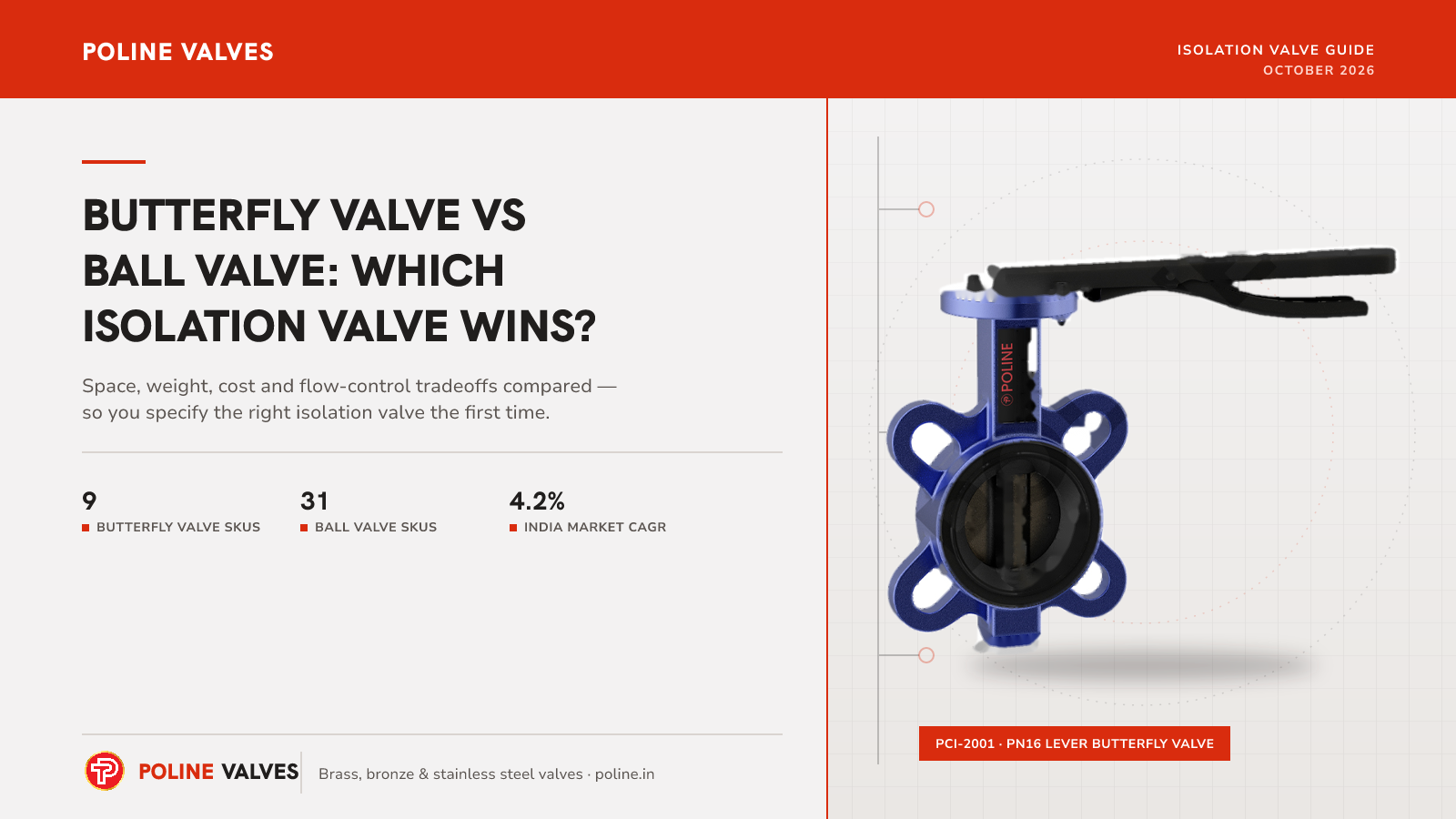
Poline's butterfly valve range covers this end of the spec directly: the PCI-2001 to PCI-2009 series, wafer-type and PN16/PN2.5 rated, with SG Iron or SS304 discs and a choice of lever, gearbox, pneumatic, or electric actuation depending on how the valve needs to be operated and how often.
When a Ball Valve Is the Right Choice
- Small-to-medium branch lines and individual connection or meter isolation points, where a resident, plumber, or technician needs to shut off supply in one quick motion, often without special tools.
- Gas service — PNG, LPG, and CGD connections — where a dependable, long-term tight seal matters even after the valve has sat untouched in one position for a long stretch, and bubble-tight shutoff isn't optional. See our PNG gas connection valve guide for the full selection checklist on this specific use case.
- Frequent on/off cycling at moderate sizes, where the speed and reliable sealing of a quarter-turn ball outweigh the weight and cost advantage a butterfly valve would otherwise offer.
- Higher pressure classes at smaller bores — forged brass, forged steel Class 800, and similar designs are built around the ball-valve geometry, not the butterfly one.
Poline's ball valve range runs from forged brass (the Callisto and Titan series — see how the Titan Series stacks up in our Zoloto vs Poline brass ball valve comparison — including EN331 gas appliance valves) through cast iron, cast steel, forged steel, and stainless steel SS304/SS316 — in 1-piece, 2-piece, 3-piece, and 3-way body configurations with screwed, flanged, or union ends.
A Real-World Scenario
An MEP contractor fitting out a commercial building's chilled-water plant room specified ball valves across the board for isolation, reasoning that a bubble-tight seal was the safer default everywhere. On the 200mm and 250mm header runs feeding the chiller plant, the valves arrived heavy enough to need additional pipe supports that weren't in the original hanger schedule, and the installed cost came in well above the mechanical budget — mostly because ball valve bodies at that bore are substantially larger and heavier than the pipe spools they sit in.
The contractor reworked the header isolation points to lug-type butterfly valves at the same ratings, keeping ball valves only on the smaller branch and riser connections where quick, bubble-tight shutoff genuinely mattered. The header valves dropped onto standard pipe supports with no rework, the mechanical budget came back in line, and commissioning went ahead without the hanger-schedule change order.
Specifying one valve type across an entire system because it feels like the "safer" choice can quietly cost more than matching each valve to its actual duty point — size, seal requirement, and operating frequency all belong in that decision, not just habit.
Selection Checklist Before You Specify an Isolation Valve
- 1Confirm the actual bore. The cost and weight gap between a butterfly valve and a ball valve widens sharply above roughly 150mm — don't default to one type without checking where your line size sits on that curve.
- 2Decide how tight the seal genuinely needs to be. Gas service and long-duration static isolation call for a ball valve's bubble-tight seat; general isolation on a large water or HVAC header usually doesn't need that margin.
- 3Check whether any throttling is required. A butterfly valve tolerates partial-open duty far better than a ball valve — but if precise, repeated flow regulation is the actual job, a globe valve is the better-built tool for it.
- 4Measure the available face-to-face space before committing to a 2-piece or 3-piece ball valve body, especially in a retrofit where the pipe spool length is already fixed.
- 5Match actuation to operating frequency — lever for occasional manual use, gearbox/handwheel for larger or harder-to-turn valves, pneumatic or electric where remote or automated operation is needed.
- 6Verify body, disc/ball, and seat materials against the media and temperature — SG Iron, SS304, brass, and WCB cast steel aren't interchangeable once you factor in corrosion and pressure-temperature limits.
- 7Ask for documentation — ISO-certified manufacturing and hydrostatic/pneumatic test records for the specific SKU, not just the product family.
Common Mistakes When Choosing Between the Two
- Defaulting to ball valves at large diameters out of habit, missing the real weight and cost savings a butterfly valve offers once bore size climbs past the point where the two types' costs diverge.
- Using a butterfly valve for bubble-tight, long-duration static gas isolation, where a ball valve's seat design is the safer, better-proven choice.
- Trying to throttle with a ball valve, which erodes the seat at partial-open positions and shortens service life — use a butterfly valve for moderate regulation, or a globe valve for precise control.
- Ignoring face-to-face length when retrofitting into an existing, fixed pipe spool, then discovering the replacement valve doesn't fit the available space.
How Poline Can Support Your Isolation Valve Requirement
Poline manufactures both butterfly valves — PN16 and PN2.5, SG Iron and SS304 discs, lever through electric actuation — and ball valves across brass, cast iron, cast steel, forged steel, and stainless steel, including EN331 gas appliance valves and Class 800 forged steel designs. Every valve is manufactured at Poline's Sachin GIDC facility under ISO 9001:2015, ISO 14001:2015, and ISO 45001:2018 certification, with hydrostatic and pneumatic pressure testing before dispatch. See also our guide to ball valves vs gate valves for water supply systems and our industrial ball & gate valve buyer's checklist. Water supply, HVAC, and industrial process are three of the sectors we serve — see the full range on our industries we serve page.
Talk to Our Team →